Physics-Informed Random Forest Surrogate Modeling for Parachute Fabric Permeability
Parachute Inflation
This project presents a physics-informed surrogate modeling framework based on Random Forests for optimizing fabric permeability in supersonic Mars landing parachutes, conducted as part of a research project under (Prof. Jason Rabinovitch) at Stevens Institute of Technology.
The method combines a Darcy–Forchheimer analytical trend model with a Random Forest residual learner, enabling accurate prediction of permeability coefficients across a high-dimensional geometric design space. The surrogate is embedded in a multi-objective optimization pipeline to identify pore geometries consistent with experimental permeability measurements.
The framework integrates:
- Pore-scale CFD simulations (NGA2)
- Physics-informed Random Forest surrogate modeling
- Global multi-objective optimization (NSGA-II, CTAEA)
- Local high-fidelity refinement
Optimization results
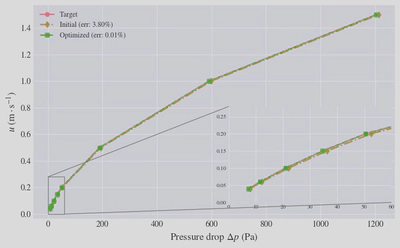
Trained on tens of thousands of CFD simulations, the surrogate achieves <10% worst-case relative error, while optimized geometries reproduce experimental permeability with <1% mean error. The resulting models provide efficient and physically consistent closures for large-scale FSI simulations of parachute inflation.
Status: 📝 Paper in preparation

Erwin POUSSI
Aeronautics & Astronautics @ Stanford | Research Assistant (MSL & Qiu Lab)
Graduate student in Aeronautics & Astronautics at Stanford, working on robot learning and autonomous systems, with a focus on sim-to-real transfer and learned control policies.